28/09/2026
The NVNM Whitepaper presents NVNM Chain as a sovereign Layer 1 for accountability infrastructure for agentic activity, built for the next generation of institutional onchain markets.

NVNM Chain: A Sovereign Layer 1 for Verifiable Agentic Markets
AI agents are moving from analysis into execution, while private markets are increasingly moving onto programmable rails. That creates a new infrastructure requirement: institutions need to know what data an agent used, how it processed that data, and what state informed its decision.
NVNM Chain is built to provide that verification layer. It is a sovereign Layer 1 designed for cryptographic attestation, allowing institutions, applications and AI agents to verify consequential activity without placing the underlying private data onchain.
The Whitepaper focuses on this infrastructure and its architecture. The companion Tokenomics Whitepaper separately covers the role of $NVNM, including utility, supply, allocation and governance.
A Sovereign Layer 1 Built for Verification
NVNM Chain is a purpose built Layer 1 focused on anchoring verifiable claims about data, processing and decisions. The chain is EVM compatible, meaning existing Ethereum tooling can work with it. Execution runs on Reth, while consensus runs on Commonware Simplex, providing deterministic finality in approximately 500 milliseconds. Gas is paid in stablecoins, giving institutional and agentic workloads predictable costs denominated in dollars.
At the centre of the architecture is a native Anchoring Module. Instead of treating verification as an application added above the chain, NVNM Chain makes registries, records and permissions native components of the Layer 1.
From Data to a Verifiable Record
The NVNM architecture connects private market documents, economic data and agent workflow outputs to a common verifiable record.
At the semantic layer, data can be structured into machine readable form. Inveniam provides the canonical first integrated data layer, connecting to existing enterprise storage, extracting and attributing information, and creating the cryptographic hashes that can then be anchored to NVNM Chain. Source data does not need to be migrated from the environment where it is already held.
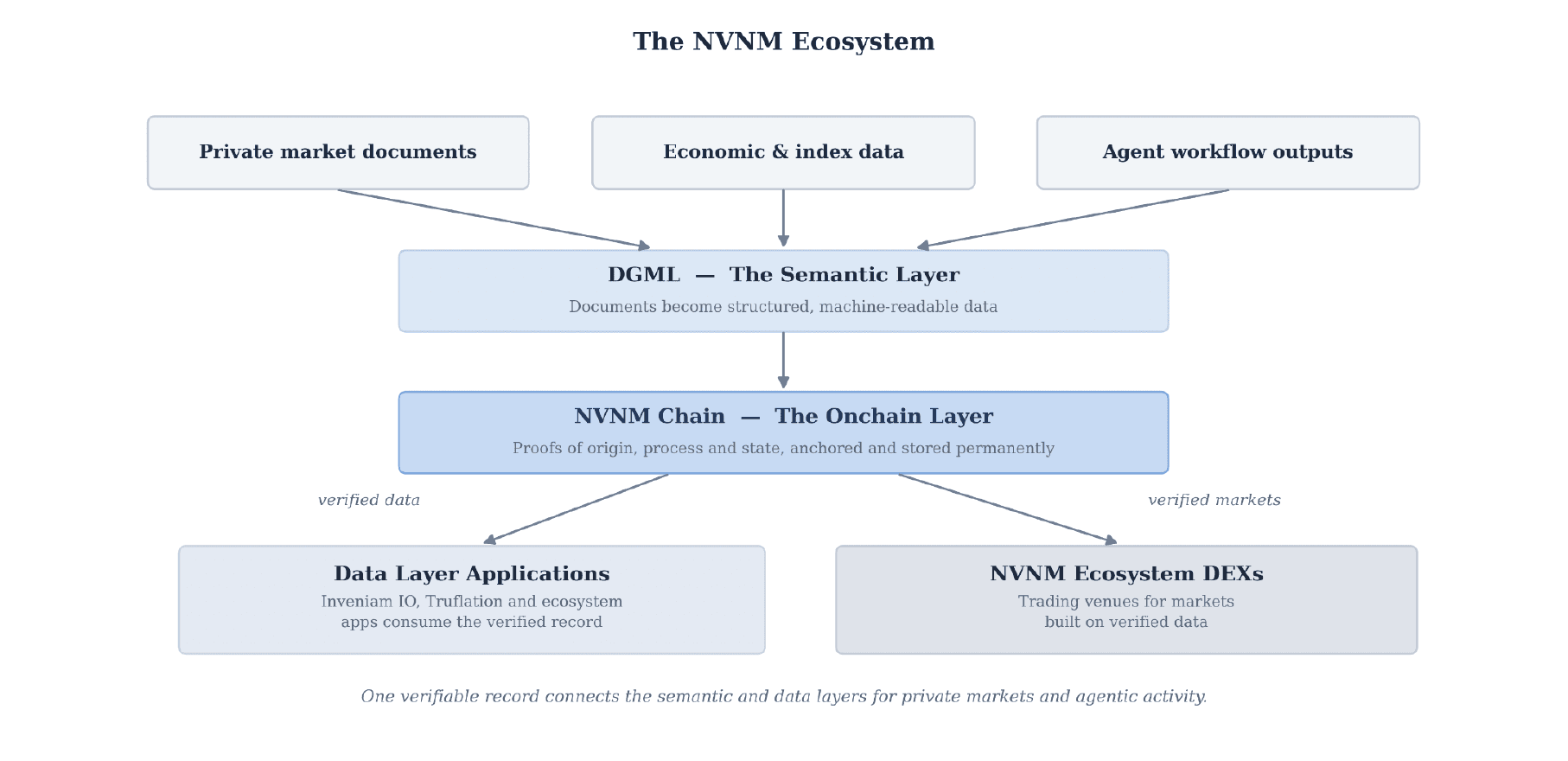
NVNM Chain then acts as the onchain Layer 1 for verification. Rather than publishing sensitive documents, the chain stores cryptographic proofs and the metadata required to verify them. The result is a clear separation between data and proof. Private information remains with its lawful custodian, while its integrity, provenance and state can be independently verified onchain.
The Architecture Behind NVNM Chain
The architecture can be viewed across three areas: consumers, access and data infrastructure, and the NVNM Layer 1 itself. AI agents, regulated venues and applications sit at the consumer layer. The MCP Server provides a typed interface through which agents and developer tools interact with NVNM Chain, while the Inveniam data layer handles extraction, attribution and cryptographic hashing.
Below this sits NVNM Chain itself. The Anchoring Module manages registries and records. Reth provides EVM execution. Commonware Simplex provides consensus and security through NVNM Chain's own validator set.
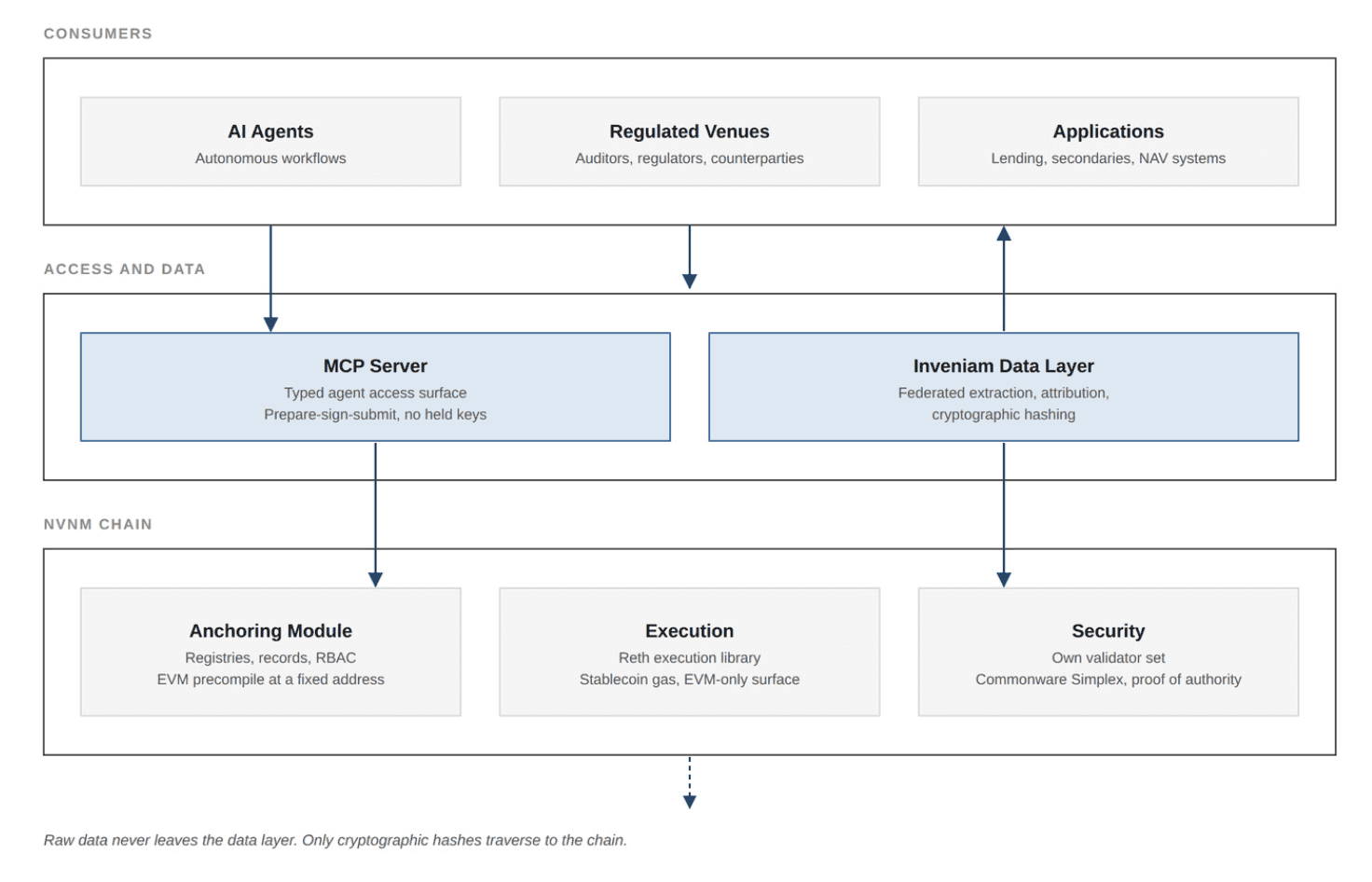
Importantly, the MCP Server does not hold private keys. It validates requests and prepares unsigned transactions, while signing takes place externally using infrastructure controlled by the operator. This gives NVNM Chain a deliberately narrow role: provide the Layer 1 infrastructure through which proofs can be created, permissioned and independently verified.
Proof of Origin, Process and State
Verification is not simply about proving that a document existed. NVNM Chain approaches provenance through three connected elements: where the data originated, what process transformed it, and which version or state of the data was used when an action occurred.
Together, these provide a much stronger record of an agentic decision. A counterparty can establish not merely that data existed, but which data was used, how it was processed and what state informed the resulting action. This is particularly important as AI agents begin making decisions across organisations where participants do not share the same databases, systems or incentives.
Institutional Permissions Built Into the Layer 1
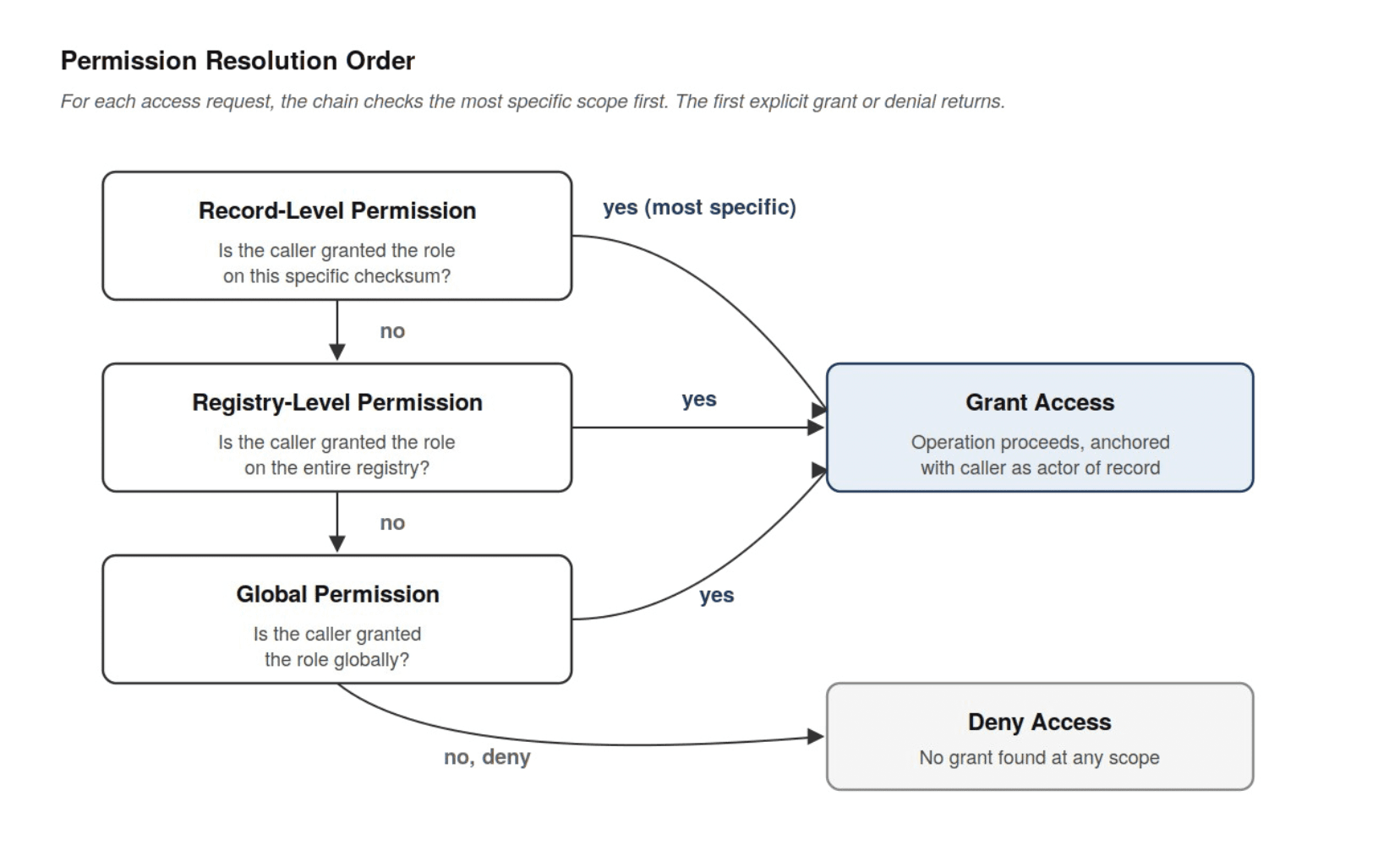
Institutional data rarely operates under a simple owner model. Different parties require different permissions across different records. NVNM Chain therefore uses hierarchical role based access control across three scopes: record, registry and global.
The chain checks the most specific scope first. A permission relating to an individual record can provide access there. Registry permissions can apply across a complete registry. Global permissions can apply across registries. If no applicable grant exists, access is denied. The aim is to make sophisticated institutional permissions understandable and auditable without introducing unnecessary complexity.
Know Your Agent (KYA)
NVNM Chain also introduces a persistent identity convention for AI agents called Know Your Agent. Each agent operates through its own persistent onchain wallet. Actions performed by that agent remain tied to the same identity over time, creating a history that counterparties can independently query.
This gives institutions a way to verify what an agent has previously done, what authority it has been given, and which actions can be attributed to it. The wallet becomes the persistent accountability layer even if the models, applications or operators around it change.
Starting With Private Markets
Private markets are the first major focus because the underlying problem is already acute. Lending markets need current and attributable collateral data. Secondary markets need defensible pricing inputs. Tokenized funds need verifiable NAV data. Regulated AI systems need persistent records showing what was monitored and what actions were taken.
NVNM Chain provides the Layer 1 verification substrate beneath these applications rather than attempting to become the application itself. The same architecture can extend beyond financial markets into regulated AI compute, supply chain verification, clinical trials and other multi party workflows where confidential data must remain private while the claims built from that data remain independently verifiable.
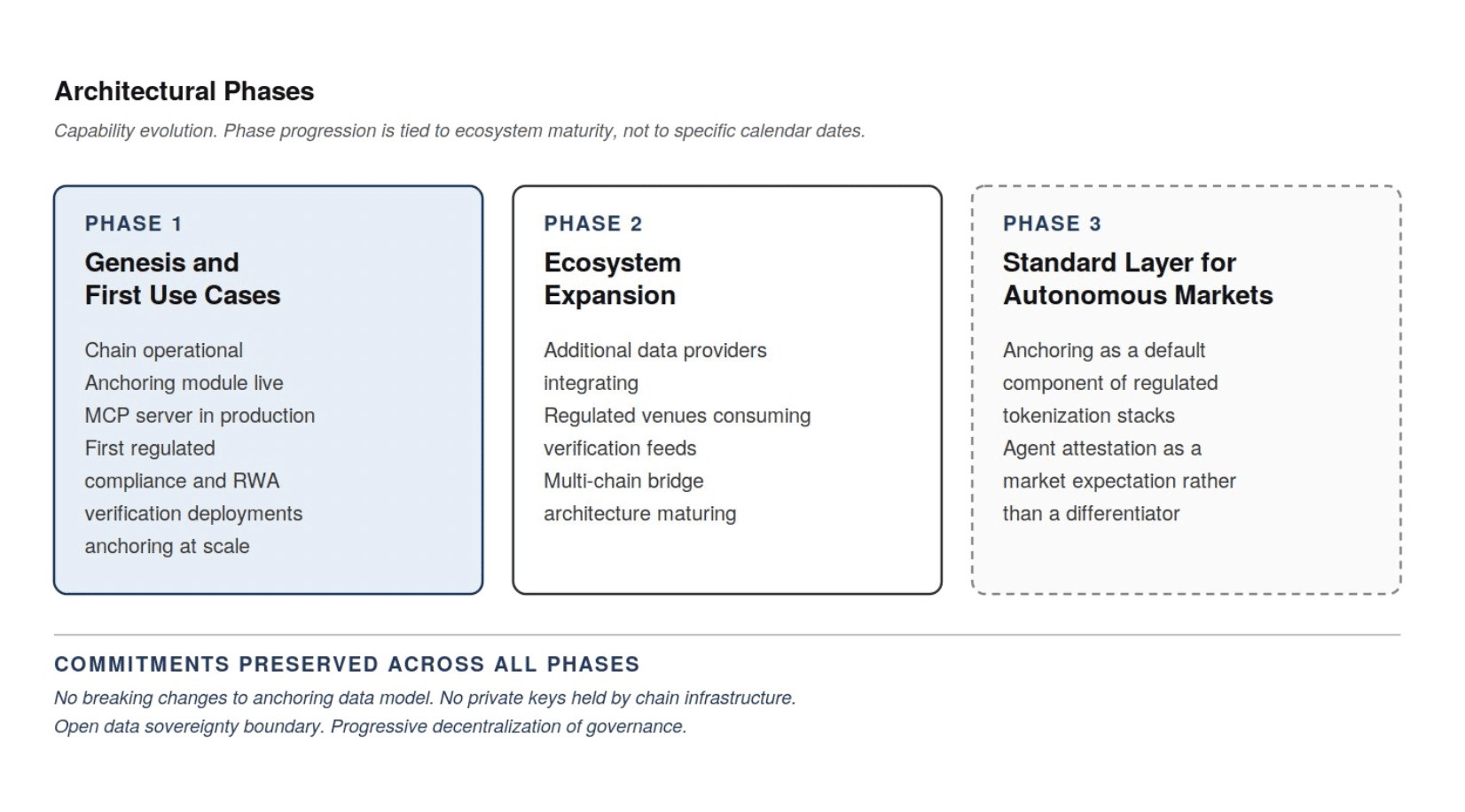
From Genesis to Autonomous Markets
The roadmap progresses according to adoption and infrastructure maturity rather than fixed calendar dates.
Phase 1 establishes the chain, the Anchoring Module, the MCP Server and the first regulated compliance and RWA verification deployments.
Phase 2 expands integrations with additional data providers and regulated venues, develops cross chain connectivity and progressively decentralizes governance.
Phase 3 positions NVNM Chain as a standard verification layer for autonomous markets, where anchoring and agent attestation become normal components of regulated digital market infrastructure. NVNM Chain Whitepaper
Across those phases, the core principles remain the same: source data stays outside the chain, private keys remain outside chain infrastructure, records remain verifiable, and control progressively decentralizes.
Building the Verification Layer for Agentic Finance
Moving markets onchain solves only part of the problem. As private assets, institutional data and AI driven workflows converge, the information behind those markets also needs to become verifiable.
NVNM Chain is being built as the sovereign Layer 1 for that task. Data stays private. Proof becomes portable. Agent activity becomes attributable. And institutions gain a common Layer 1 through which increasingly autonomous markets can verify what happened, what information was used and who was responsible. Read the full NVNM Whitepaper PDF here.
Explore more